
Limited Time Offer Extended - Get $300 off when you book our upcoming retreat by November 27th with code: SACRED300. Terms apply!

Huachuma Ceremony Peru
Huachuma (San Pedro) Ceremony in the Andes
Traditional Chavín Mesa Practice
Huachuma, also known as San Pedro, is one of the oldest ceremonial plant medicines of the Andes.
For thousands of years it has been used by Andean curanderos to cultivate clarity, balance, and right relationship with life.
Where Ayahuasca is often associated with purification, Huachuma works in a quieter and even deeper way.
Huachuma guides people to what must be seen.
It stabilizes.
It clarifies.
It helps a person walk forward with integrity and responsibility while being fully reconnected with oneself.
In the Andean traditions, Huachuma is approached as instruction.
At Banco Puma Sanctuary the Huachuma ceremonies follow the Chavín lineage of the Andes, one of the earliest ceremonial cultures of ancient Peru.
What Huachuma Is
Huachuma is prepared from the Echinopsis pachanoi or the Echinopsis Peruvianus (the latter being the option we use), a plant that grows throughout the highlands and coastal regions of the Andes.
Unlike many ceremonial medicines that are approached only for visionary experiences, Huachuma has traditionally been understood as a medicine of orientation.
Participants often describe the experience as gaining a wider perspective on their lives.
The medicine tends to quiet internal noise and allow a person to see situations more clearly.
Rather than pushing the mind into intensity, Huachuma often creates a sense of steadiness.
Because of this quality it has long been used by Andean practitioners as a medicine that helps people restore balance and direction.
The Chavín Tradition
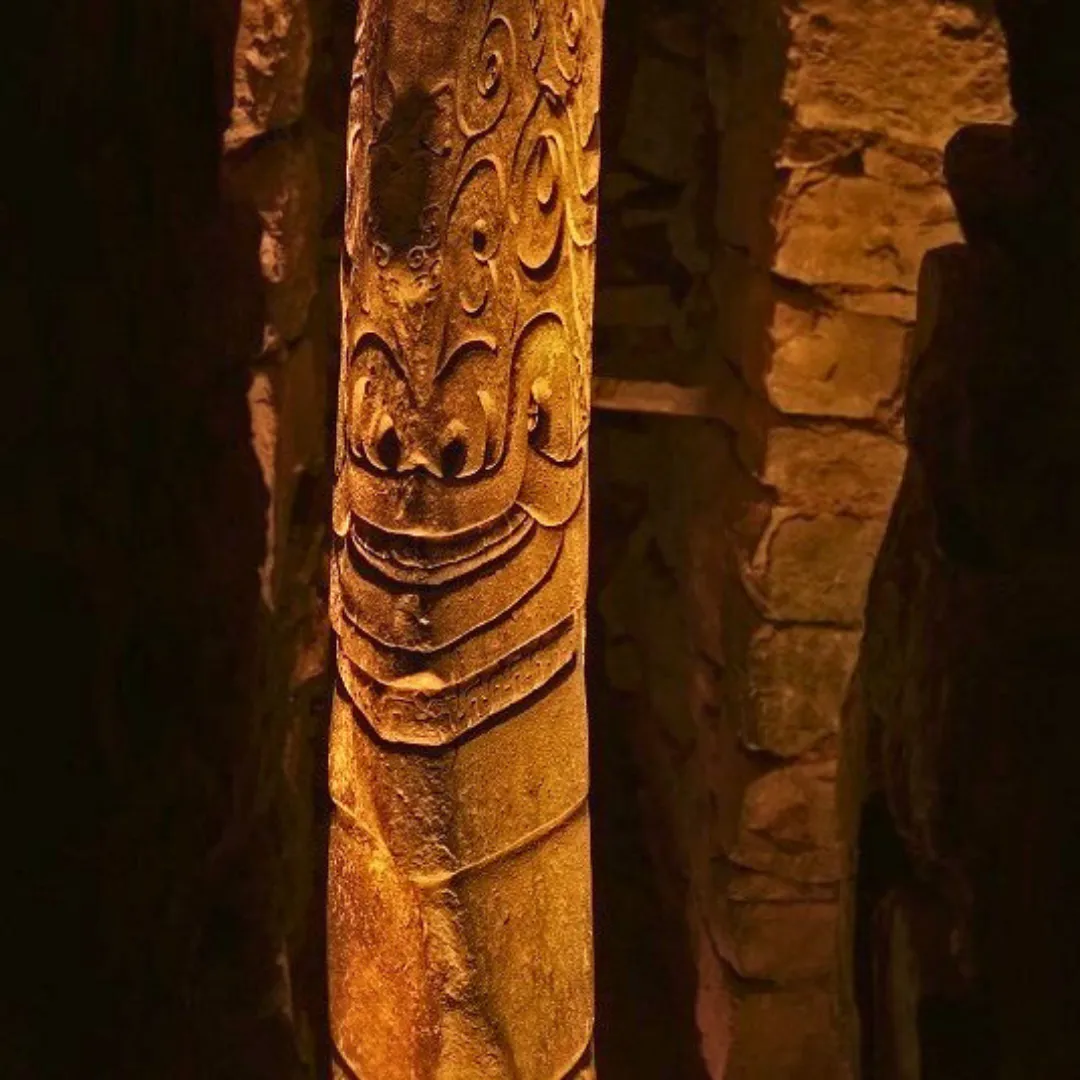
Archaeological evidence shows that Huachuma ceremonies were already practiced more than three thousand years ago within the Chavín culture.
The ceremonial center of Chavín de Huántar in the Peruvian Andes is one of the earliest known spiritual complexes of the region.
The ceremonial traditions associated with Huachuma reach back to this early Andean culture, long before the rise of the Inca and the later civilizations that followed.
Stone carvings, temple corridors, and ceremonial iconography from this culture show the San Pedro cactus as a central element of ritual life.
Within this tradition the cactus is not approached as spectacle.
It is approached as a teacher.
The ceremony unfolds slowly, often across the day, allowing participants to move through the landscape, sit with the mesa, and observe the subtle ways the medicine clarifies perception.
Rather than producing overwhelming visions, Huachuma tends to bring steadiness and reflection.
For this reason Andean traditions often describe it as a medicine that teaches a person how to walk correctly in life.
The Chavín Mesa
Huachuma ceremonies at Banco Puma Sanctuary are guided through the Chavín mesa, sometimes also referred to as the Chavín mesada.
A mesa is not simply an altar.
It is a ceremonial field built through years of disciplined practice.
Each object placed within the mesa carries a specific role in the work, and the arrangement reflects the lineage through which the medicine has been transmitted.
Within this ceremonial framework the work often moves through what Andean traditions describe as the three worlds, the lower world, the middle world, and the upper world, reflecting different dimensions of human awareness and relationship with nature.
Rodolfo received the discipline of the mesa through years of apprenticeship under the late Maestro Don Howard Lawler.
This transmission was not a certification or training program.
It was a process of repetition, observation, and responsibility carried through many ceremonies over time.
The mesa is held today in the same structure in which it was received.
Nothing has been modified or reinterpreted.
Where Huachuma Is Held
Huachuma ceremonies connected to Banco Puma Sanctuary may take place in two locations.
At times the work is carried within the Amazon grounds of Banco Puma after the Ayahuasca cycle has concluded.
At other times the ceremonies are held directly in the Andean landscape of Chavín de Huántar itself.
Working with Huachuma in Chavín is not a symbolic reference to the tradition.
It is the place where this ceremonial current first took form thousands of years ago.
When the mesa is carried there, participants are stepping into the same landscape where the medicine has been practiced across generations.
Both settings follow the same ceremonial discipline.
The intention is not to create spectacle around the medicine but to place participants in environments where the work can unfold naturally.
Why Huachuma Follows Ayahuasca
Within the ceremonial structure practiced at Banco Puma Sanctuary, Ayahuasca comes first.
This preparation phase is essential and is explored in more detail in the context of traditional Ayahuasca ceremonies in Peru.
Ayahuasca reveals.
It clears what is misaligned and exposes the areas of life that require attention.
Huachuma follows afterward.
Its role is different.
Rather than opening new material, Huachuma helps stabilize what Ayahuasca revealed.
In traditional practice the two medicines are separated by several days so the transition from the Amazonian work into the Andean work can unfold in a steady and grounded way.
Participants often describe gaining perspective on their lives from a calmer place.
The medicine supports clarity, integration, and direction.
This sequence reflects the relationship between the Amazonian and Andean traditions that carry these medicines.
Ayahuasca prepares the ground.
Huachuma teaches how to walk it.
Working With Huachuma at Banco Puma Sanctuary
Huachuma retreats at Banco Puma Sanctuary are held in small ceremonial groups so the work remains steady and properly guided.
Participants may attend the Huachuma work individually or as part of the full ceremonial cycle that begins with Ayahuasca.
Ceremonies are carried through the Chavín mesa discipline and held either on the sanctuary grounds or within the Andean landscape of Chavín itself.
The Huachuma ceremonies are guided by Rodolfo De Angeli, who carries the Chavín mesa through the apprenticeship lineage of Maestro Don Howard Lawler and continues that work within the same disciplined structure.
Those who feel called to approach Huachuma within this traditional context can view the upcoming retreat dates and understand how the work is held across the full ceremonial path at Banco Puma Sanctuary.
Retreats are held in small ceremonial groups of six participants so the work remains personal, steady, and properly guided.
MAIN MENU


